
Fees & Insurances
Fees
My fee for individual therapy, supervision, and mitigation work is based on a “tier” anti-oppressive rate structure. Why? Many reasons! The capitalist system that we all exist in oppresses folks with less access to financial privilege - making it increasingly harder to get support and mental health care.
Our access to finances are largely determined by our race, gender, disability or ability, citizenship status, language, generational wealth, and many other factors. This pricing system allows for both individual reflection on access to wealth and resources, and encourages folks to pay according to their financial access.
Most importantly, this system allows for me to be able to offer reduced fees or “sliding scale” spots that are prioritized for folks who hold one or more of these identities: Black Indigenous People of Color, gender expansive, trans, and non-binary folks, and disabled people. When you pay in Tier 3 Redistribute and Give Back, you are supporting my ability to provide support to those with less financial privilege and helping to counter the systemic oppression of resources for folks with the above identities.
I am committed to being a part of increasing access to care by offering reduced fee or “sliding scale” options. My fees and sliding scale options are based on my critical reflection of my own financial privilege, access to resources, and ability to continue to support and serve my community.
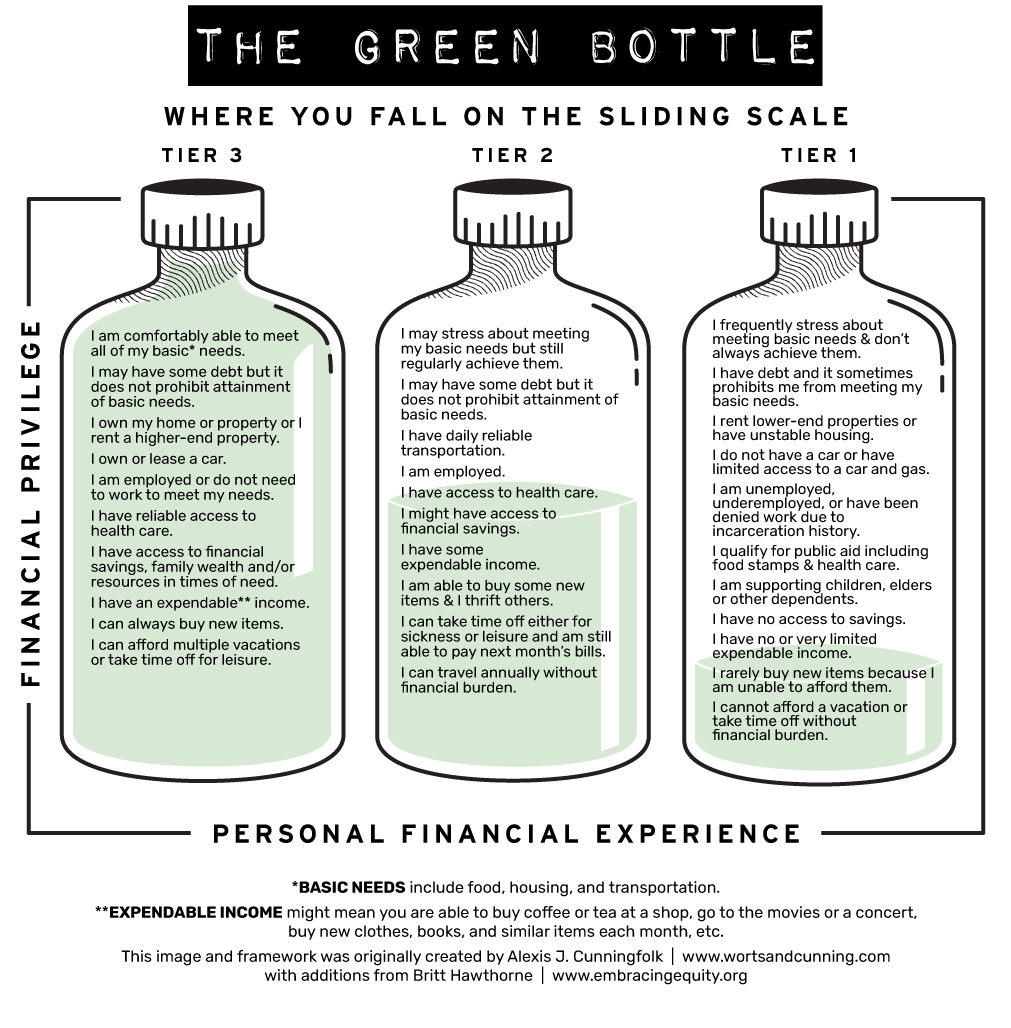
Please refer to the Green Bottle infographic for guidance on which tier you fall into. If you are unsure, please reach out and we can chat about what fee/tier makes the most sense for you!
-
You might fall into tier 3 if you:
Can comfortably meet all of your basic needs
Own your own home or property, or rent a higher-end property
Own or lease a car
Employed or do not need to work
Have reliable access to health care
Have access to financial savings, family wealth and/or resources in times of need
Have access to expendable income
Can always afford to buy new things
Can afford vacations or time off for leisure
-
You might fall into tier 2 if you:
Stress about meeting basic needs but still regularly achieve them
Have some debt, but it does not limit attainment of basic needs
Have daily reliable transportation
Employed
Have access to health care
Have access to financial savings
Have some expendable income
Able to buy some new things and thrift others
Can take time off for sickness or leisure and still be able to pay next months bills
Can travel annually without financial strain
-
If you do not fall into Tier 2 or 3, you may fall into Tier 1. This can range from $65-$150. These spots have limited availability.
Aetna
Anthem & Anthem EAP
BC/BS
Careleon
Cigna
Independence Blue Cross Pennsylvania
Kaiser Permanente Colorado (Denver-Boulder area)
Oscar
Oxford
Select Health
United Healthcare
Please note that if you have CO Medicaid, I am not an enrolled provider and cannot accept self-payment. If you have Medicaid as a secondary insurance, I may be able to take your primary insurance. Refer to Colorado Medicaid’s Rights and Responsibilities for more info.
Insurances Accepted
Fees for consultation, supervision, and mitigation forensic work are detailed on their relevant pages.

Good Faith Estimate
Under Section 2799B-6 of the Public Health Service Act, health care providers and health care facilities are required to inform individuals who are not enrolled in a plan or coverage or a Federal health care program, or not seeking to file a claim with their plan or coverage both orally and in writing of their ability, upon request or at the time of scheduling health care items and services, to receive a “Good Faith Estimate” of expected charges.
You have the right to receive a “Good Faith Estimate” explaining how much your medical care will cost
Under the law, health care providers need to give patients who don’t have insurance or who are not using insurance an estimate of the bill for medical items and services.
You have the right to receive a Good Faith Estimate for the total expected cost of any non-emergency items or services. This includes related costs like medical tests, prescription drugs, equipment, and hospital fees.
Make sure your health care provider gives you a Good Faith Estimate in writing at least 1 business day before your medical service or item. You can also ask your health care provider, and any other provider you choose, for a Good Faith Estimate before you schedule an item or service.
If you receive a bill that is at least $400 more than your Good Faith Estimate, you can dispute the bill.
Make sure to save a copy or picture of your Good Faith Estimate. For questions or more information about your right to a Good Faith Estimate, visit www.cms.gov/nosurprises